
Gut Check
Trust-building exercises in action


On the train home from New London, I consider my options.
It’s a Sunday afternoon in July. I’ve just spent the weekend in Block Island with one of my best friends. A bright, breezy 72 hours of cocktails and Adirondack chairs and the fresh, open ocean. A cure for the heaviness of my life if there ever were one. I leave Connecticut that morning bouyed by the idea that the rest of the summer will bring the same kind of ease and healing.
But it doesn’t last. Storm clouds roll in quickly as the Amtrak pulls out of the station, and suddenly I’m aware that I am alone on a Sunday afternoon, staring down the barrel of the rest of my life. Outside the windows, it’s starting to rain. I buy a mini bottle of pinot noir from the cafe car and drink it over the span of one indie-sad Spotify playlist. This does not make me feel better. In fact, that dull, pounding sensation—the one that sits in my mouth during my walks to work and pulses up the back of my neck in the dark of dive bars and concert venues—has settled into the empty seat next to me. Turns to me and says,
Is this all there is?
The train is going all the way to Washington. New York City is just a stopover. I think about doing it: not getting off. Speeding another four hours south, waking up to a pitch-black sky in a different city. I could do it. Call in sick to work, book a hotel room, wander the streets and museums until that feeling fades. The feeling that this life is not my own, and that had I been given a choice, I would not have chosen it.
Of course, I’m being dramatic. At least, this is what I tell myself to shake loose of the idea. It rains all the way to Penn Station. I decide against another bottle of wine. When the train stops, I gather my bags and get off. At home, no one is waiting for me. I have no idea if my conformity is cowardice or pragmatism.
There’s a scene in Girls (HBO) that’s been making the rounds on TikTok lately. Hannah, post-manic haircut, wanders into the kitchen in just a T-shirt and says to Laird, “I’m feeling just a little bit frail…I haven’t been eating that much, so I don’t know if I look like, scary thin or anything.”
But the part that usually gets cut out of the edits comes right after. She then says: “You know when you’re young and you drop a glass, and your dad says like, ‘Get out of the way,’ so you can be safe while he cleans it up? Well, now no one really cares if I clean it up myself. No one really cares if I get cut with glass. If I break something, no one says, ‘Let me take care of that.’ You know?”
I do know. In my early 20s (around the same age she is in that scene), this was the source of most of my anxiety.
The crest of this anxiety marked the low point—the bare and rocky bottom—of that first season of grief. Drunk and aimless. I felt the weight of Death then, its slow claws, perpetually as something wet and sticky, like a stain I couldn’t scrub off. Now, if I had to identify it, I’d say it makes me think of a dull pounding. The kind that sits in the spine and the fingers and the teeth.
My fear during that year grew like a wildfire. My parents were 3,000 miles away. My friends, preoccupied with boyfriends and stresses of their own. I had no job, no romantic prospects, and the comfort of my childhood seemed to have been extinguished with the violence of a single afternoon and the delivery of a diploma.
I am acutely alone, I realized for the first time in my life. Like, ALONE alone. Solitary and slick with the smell of death. No one is coming to save me.
At 22, I had absolutely no clue what would make me feel good, let alone safe, so I threw myself at any type of distraction. If I was awake, I didn’t want to be sober. If I was out, I didn’t want to go home. If I did have to go home, I didn’t want to go alone. I spent most of my time flailing around wildly, and feeling sad about it. The afternoons were for sweating into a Raymour & Flanigan couch in Astoria and taking long, drunk showers in an ancient clawfoot tub. At night, I’d take $50 Ubers into Manhattan or Williamsburg and drink until I either didn’t feel sad anymore, or until the feeling became unbearable. I’d Irish exit and go home crying to Bruce Springsteen, or worse: wake up in sparse, musky apartments in Jersey City or the Lower East Side.
There is an essay I wrote in 2020, never published, that I go back to often only because it remains the clearest articulation of that period of my life:
It would be easy to say that I started sleeping around then because I was lonely, but what I wanted at my core was to become someone I recognized again. If I let someone get inside me I might also find my way back inside myself.
Once I latched onto that idea, I felt hungry for it all the time. I’d go to dive bars with cute, forgettable guys I had met on Tinder and pound bottom shelf gin until I felt empty enough to want to fuck them. Soon, I began to be haunted by a nagging, insistent fear: that if I didn’t feel someone touching me, I might literally disappear. I craved it constantly—not even sex, just the comfort of a man’s warm body wrapped around me in the dark.
Yes, it would be easy to say I started sleeping around—and continued to—because I was lonely. But it wouldn’t be true.
I have been lonely plenty of times in my life, but it’s rarely ever been the thing that’s made me reach for another person. When I have picked up the phone, or opened an app, or agreed to a last-minute date on a school night with a predictable stranger, it’s been out of boredom. And, under that: the hope that something good (or at the very least, exciting) might come out of it.
Embarrassingly, at every difficult moment in my life—and I mean the deep dark of Difficult like when it seems like maybe it would be better to just throw in the towel—I think: I need something good to happen to me. It’s a thought I’ve had over the last six months, and over the last ten years. Are you there God? It’s me, again, hoping something will fall out of the sky and turn it all around.
In Joan Didion’s The Year of Magical Thinking, she repeatedly circles back to “the question of self-pity” when she considers her grief in the wake of her husband’s death. To what extent, she asks, are we allowed to feel sorry for ourselves? If I feel sorry for myself, for all the things that happened without my permission—the slow claws of death, the violence of an afternoon or the blank space of a hospital room—does it mean I’m wallowing? No, I don’t think so. To sit with suffering is to heal from it.
But consider the other side of the coin: Have I suffered more than anyone else? Not particularly. It all comes out in the wash. 1
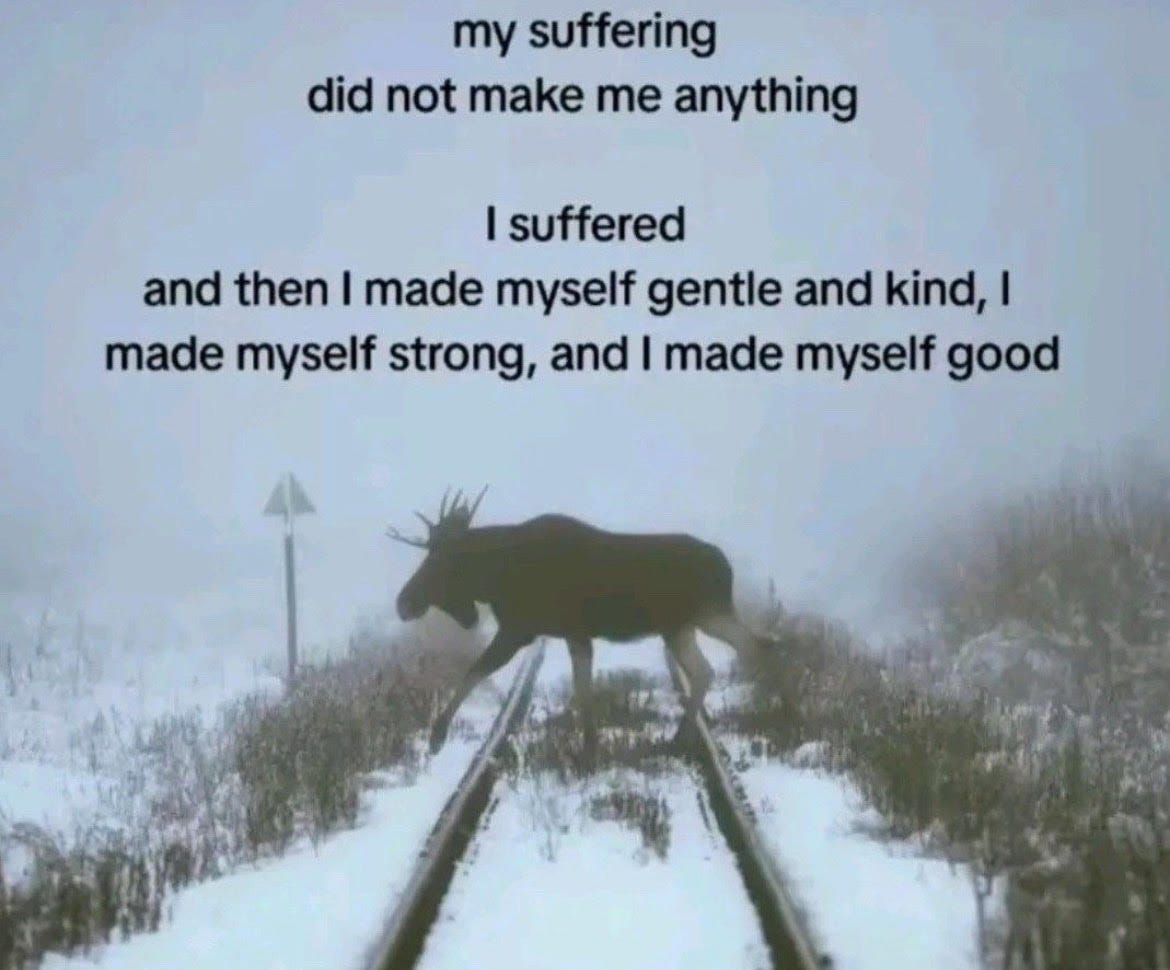
When I most recently had that thought, I wish something good would happen to me, I realized that this was not the right framing. The idea itself is passive and inert, even the syntax invokes that feeling of waiting, something I have long grown tired of. It’s not that I need something good to happen TO me, it’s that I need to make something good for myself.
No one is coming to save me. What a relief.
It turns out—another embarrassingly obvious revelation—that self-trust is the antidote to the anxiety that plagued me through my 20s. Building that trust did not happen overnight. It took years of repeating the same patterns (blurry nights at dimly-lit cocktail joints; a stranger’s rough hands digging into the soft flesh of my hips in a dark, cramped apartment; below-freezing cab rides at 6am over the Triboro Bridge) for any small shift to take place.
The other night, cooking dinner and listening to music—a healthy, sober dinner, accompanied by candlelight, a large water, and an early bedtime; the exact manifestation of those small shifts over time—Fleetwood Mac’s Landslide comes on shuffle. When Stevie Nicks asks, “Can I handle the seasons of my life?” Reflexively, out loud, I answer, “No?” I have to be real with you Stevie, I really do not know if I can.
But hadn’t I survived before, younger and less attuned? Yes, sort of. In that same essay from 2020 I had called it “a white-knuckle summer.” I wanted this time to be different. No vice grip on my dread, no mess spilling over because of it. At the core, the desire to control is the antithesis of trust. If I trusted myself, I wouldn’t have to hold on so tightly.
Truthfully, if I told my college self everything that would happen next—if I laid it out on paper, a chronological list—all the loss, the aimless questions, the sleepless nights in men’s beds that never amounted to anything, and that lingering stain—I don’t think I would do it. If I had a choice, I would not have chosen it.
Sometimes when I lie awake in bed playing solitaire on my phone I think of the patterns in my life like a deck of cards. Red and black and red and death and death and death. I sleep and wake alone. I confuse my bed for someone else’s.
The question of self-pity. Is this all there is?
On Father’s Day I blacked out after a steak dinner alone. The solo steak dinner—an expected event; the blacking out—a rarity, and mortifying. On the long, rambling walk home in the dark afterwards, I sent three consecutive “I miss you” texts to a man I should have erased years earlier, something that upon realizing it the morning after made me want to drink bleach.
But I woke up the next day and and instead, took it all back. I blocked the number, I made the bed. This is how I build the bricks of trust.
At the tail end of her memoir, Didion says, “I also notice that I do not have the resilience I had a year ago.” You and me both, babe. Six months ago I felt I had some kind of bravado propelling me forward. My spine had been shocked straight and steely. I do not feel so brave anymore. The absence of self-destruction in my life is due only to muscle memory.
At all moments I am bumping into my old self, feeling the same temptations. But I am not my old self. I have worked too hard for my peace to give it all up for fear.
I know how to take care of myself now. I shower and do the dishes. I cook dinner, light candles. Put a record on. I go to the beach when the stale air of summer gets too oppressive. The cat eats the flowers but I buy them anyway. I take a long walk at dusk when the stale air of my life gets too oppressive. Stevie Nicks asks me if I can handle the seasons and this time, I consider it.
I still get scared of losing control sometimes.
I wonder what would happen if I gave into my urges. Ride the Amtrak all the way to D.C. Stay on the F train until Coney Island. Bite down on something hard until my teeth crack. I still don’t know if restraint is cowardice, if I’ve just bound myself with a different type of rope.
A favorite mantra of my dad’s was the classic Buddhist principle, “Desire is the root of all suffering.” I do not disagree with this. Often, I think, if I wanted nothing I would be free. I’d never have to experience the sting of loss or rejection or the cavernous enormity of desire itself. But I’m not built for that.
“But longing is momentum in disguise: It’s active, not passive; touched with the creative, the tender, and the divine. We long for something, or someone. We reach for it, move toward it. The word longing derives from the Old English langian, meaning ‘to grow long,’ and the German langen—to reach, to extend. The word yearning is linguistically associated with hunger and thirst, but also desire. In Hebrew, it comes from the same root as the word for passion. The place you suffer, in other words, is the same place you care profoundly—care enough to act.”
-Susan Cain, from Bittersweet: How Sorrow and Longing Make Us Whole (Crown, 2022)
Longing is momentum in disguise, I repeat like a prayer when it feels like I’m standing still, or going backwards. If I want something, anything—a text back, a stiff drink, a life-altering romance—I’m still alive. Stagnancy is death’s less interesting cousin. When I said to myself years ago, on the precipice of a new season, “I am ready to suffer again,” I think I had the right idea. I’d rather suffer over and over, make the same unforgivable mistakes,2 as long as it means there are still days ahead of me to take it all back and do it better.
Tomorrow I might wake up and do something stupid. I could get drunk in the afternoon and go home with someone who doesn’t know me; rot in bed and pick apart my choices and my appearance until I feel like I’ve gone ten steps in the wrong direction. I don’t know that I will. At the very least, I’m done white-knuckling it. I am taking my hands off the wheel. And I can promise myself this: Even if I go off the rails this time, I’ll just keep going.
The Year of Magical Thinking, Joan Didion