
Growing Pains
It's been real and it's been fun but it hasn't been real fun

I have a ritual I like to do on Friday mornings. I wake up an hour before I have to log on for work and go into my living room, light a candle, and pour a cup of cold brew and cream into a mug that says “Life is Fucking Relentless” with an illustration of a crab smoking a cigarette on it. Then, I sit on the couch with the cat in my lap and watch TikToks until I feel like my brain has been sufficiently smoothed.
While doing this the other morning, I saw a video that shocked me. Between the tarot card readings and GRWM for a first date, there it was: a nostalgia-inducing compilation of clips of New York City set to “Roses” by The Chainsmokers, with text that read In one month, 2016 will have been a decade ago.
After some quick math to determine the validity of that statement (26 minus ten is, in fact, 16!) I got so irritated that I had to put my phone down.
The caption on the video, and the corresponding comments, all said something to the effect of “wow, was 2016 the best year of everyone’s life?” Or “2016 was really the last time we all felt alive.” For a moment, I nodded my head. So true: fleeting memories of listening to EDM in my Astoria bedroom or drunk in the backseat of a taxi over the Kosciuszko Bridge speeding towards a loud, blurry night at Houston Hall or One and One. But then I stopped to actually consider it.
That long summer and the winter that preceded it—the months right out of college when I didn’t know anything besides the rough fabric of the living room couch and the taste of cheap wine—could hardly be described as A Good Time.
But in the dark days of 2016, I still tried to suck all the marrow out of my nights, even when I wasn’t having any fun. I remember the exact moment I knew I needed to go on antidepressants (another story for another time): I was in a cab on the BQE after midnight on a Sunday, Flume in my headphones, coming home after a bender spent in my friend’s sixth floor walkup on Orchard Street.
It had been, ostensibly, a great weekend. Good times, plenty of laughs, hot guys, no drama. But I felt nothing. Not the serotonin crash of a comedown or a mildly contented exhaustion. I looked at the skyline racing by outside the window, pinpricks of light that used to thrill me, and I reached down inside myself for a feeling, any feeling, and came up empty handed.
Some days, an impossible almost-decade later, still feel like that.
A friend once told me that I had “the curse of FOMO.” He said this to me as I was procrastinating leaving a party which had dwindled down to the embers of the afters. It was nearly 2am, there was at least one person asleep on the couch, and I had an early flight to catch in the morning. But still, I hesitated. What if something exciting or formative or life-changing happened in the moments after I was gone?
The summer of 2019—another strange in-between and drunken season that I find myself going back to a lot these day—had the urgency of that fear. In a few short years, I had bent to the will of Lexapro and then kicked the habit; I had moved to Bed-Stuy and was living with a stranger for the first time since I was 18. I no longer spent my weekends taking cars into Manhattan but instead booked Friday night Tinder dates in South Brooklyn that found me dragging myself home the next morning hungover but invigorated, only stopping for a quick shower before I was on the G train with wet hair in shorts and sneakers heading off to day drink with friends in Williamsburg or Gowanus.
What I loved about that summer was the novelty of it. Everything felt fresh—doors unopened, neighborhoods unexplored, the vast expanse of New York City still able to conjure up some unseen magic even after years of repeating the same patterns.
So when the TikTokers call back 2016 with its crop tops and backyard parties, I imagine the feeling they’re reminiscing on is the one I had then, a few years after the fact: an endless summer where your friends never have to go home and you never have to be held accountable for anything.
Some days, only the very best ones, still feel like that.
I don’t like going out on the Lower East Side anymore. It’s possible that’s because I’m old and embittered now, and I don’t like feeling tired and frumpy in the face of the 23-year-old Instagram models that haunt the street corners (where I was once also 23 and hungry), but mostly it’s because every cocktail bar and dive there—even the ones that changed their names and got a paint job—is a place I’ve already been before.
I feel my own ghost there, trapped by expectations that never came to fruition: naively imagining life would be a screenplay in which my short black skirts and cheap velour heels were the costume of someone striking and aloof and effortlessly cool, not an insecure post-grad chasing some semblance of familiarity at the bottom of a gin and tonic.
It’s a stain on the entire neighborhood, from Manhattan Bridge to the Bowery. I’m a grown up now, but across the river I’m still sad in the back of a taxi; I’m restless in the candlelit corner of a bar on Allen Street; I’m faceless in the mirror of a graffitied bathroom while someone’s pounding on the door outside.
There are still Friday evenings now when I’m putting on eyeliner and listening to music with a glass of wine in hand, and I feel the shape of those old nights pressing up against my spine like a vestigial limb. And sometimes, a song from my college playlist will come on shuffle and I’m sucker punched by nostalgia for the span of three full minutes. And a part of me asks: Didn’t I have more fun back then? Didn’t I feel freer, more beautiful, more excited about life?
No, not really.
When that Bacardi-soaked voice—dressed in tight polyester and smelling of burnt hair and Marc Jacobs’ Daisy perfume—comes calling like a devil on my shoulder, I reason with her. What I miss is a time and place that never existed, a fantasy that never made it off the barstool. To imagine it differently would be its own kind of tragedy.
I was happier then. Or was that I? Or am I now I? Can’t bring back time. Like holding water in your hand. Would you go back to then? Just beginning then. Would you?
— James Joyce, from Ulysses
I always want to drink on Wednesdays.
Not in an alcoholic way (another topic for another time), but in a restless way. I start the weeks sober and satiated—clean laundry, groceries in the fridge, ten thousand steps and bed by 11pm. But after 48 hours of being good, I get bored. I start to crave the possibilities of a dark bar or the excitement of anything besides sitting alone with the cat watching old episodes of Grey’s Anatomy.
I try to curb the impulse. At this age, wine gives me a headache and alcohol at large often makes me wake up in the middle of the night with heart palpitations. But I still need something to get me to the other side of the week.
So after work one Wednesday in November, I let my intuition and impulses lead me. On my roundabout walk home from the subway, I decide stop in a bookstore and blindly pick out whatever I think will bring me momentary joy—a beach read romance or a something serious and literary. This kind of indulgence is on par with a steak dinner, especially since I have shelves of unread books waiting for me at home.
I land eventually on a bright, rainbow-colored paperback with a familiar name on the spine. The story, according to the back cover, is about a woman in New York City feeling bored at middle age, trying to accept her father’s imminent death, and wondering if there’s anything she could have done differently to end up somewhere else in life. I buy it immediately.
This Time Tomorrow is, inherently, a time travel book. Which is a fun coincidence, because the author Emma Straub is the owner of Books Are Magic, my local bookstore when I lived in Boerum Hill, a bookstore that I directed my dad to many times when he came to visit me. I won’t spoil the whole plot, but essentially the main character goes back in time to her 16th birthday, a kind of reverse 13 Going On 30 to figure out where exactly she went wrong, and how she can change the future.
I loved the book and its characters—the quirky Upper West Side apartment and the narrator’s longtime childhood friends and the laidback father who’s a writer and watches Jeopardy! every night—for obvious reasons. But I couldn’t imagine myself making the same choices as the protagonist.
As a canonically sensitive person, I have always experienced my relationship to the past as one of two things: devout, bleeding nostalgia or complete detachment. I didn’t know until recently—blame it on the wet blanket of grief or the even-keeled nature of maturity—that I could have an in-between. That I could reach back and feel tender and sad and hopeful and embody all the aches of those moments without getting stuck in them.
For me, that’s the only time travel I need: the tense span of a three-minute song, the whiff of a sweat-soaked perfume or a cheap grain alcohol. It used to be that the scent of a specific Burt’s Bees chapstick could teleport me to a messy dorm room in a frozen January. It doesn’t smell like anything to me anymore. I still love the past, but I have no desire to go backwards.
The efficacy of the traditional Kübler-Ross stages of grief have been contested for a while, but the one that I’ve always had a problem with is bargaining. I understand the concept perfectly—I’ve had my own versions of magical thinking, I’ve wished things hadn’t happened or had been a dream I could wake up from, but I’ve never once imagined that I could reverse the past. What’s the point in bargaining? Whatever happened has happened. Even with all my attempts at writing fiction, I can’t pretend that it hasn’t.
After Jake died, I worried I would have nightmares about it, the kind of violent, grotesque visions I had as a kid about bodies and burials that made me sleep on my parents’ floor for an entire summer. But it never happened. I had vivid, intensely warm dreams for weeks—ones that had me waking up in a hotel room at a Punta Cana resort over spring break thinking about resurrection—but never anything bad.
The only nightmare I ever had about my friends being dead, about anyone being dead, is one in which it never happened. Since I was 22, I’ve had an infrequent, recurring dream where the person who’s died returns suddenly, arriving to a party fully alive and well. And they tell us that they were never actually dead, that it’s all been some sort of misunderstanding or elaborate prank or a necessary period of hiding, whatever. There’s a massive relief, always, but then a sense of resentment and confusion. Both because my waking mind knows it’s not true, and because I’ve already suffered in real time regardless.
In one version of these dreams, I remember saying to the person returned, “How am I supposed to make sense of my life now if you’re not dead?” Once, I had another nightmare along the same theme, in which another of my childhood friends died, and in the dream I said aloud, “If I had ten friends and three of them are dead, then what does that make me?”
I think the human brain synthesizes and adapts to change faster than we give it credit for. I don’t know the answer to those subconscious questions, but I know the origin of them: Grief changed me profoundly on a cellular level from that first phone call, and has now again a few times over. My body knew it before I did. Imagining I could reverse it is like wishing I could regrow my baby teeth.
Richard Siken says it best: We are all going forward. None of us is going back.
I’m free, I think. I shut my eyes and think hard and deep about how free I am, but I can’t really understand what it means. All I know is I’m totally alone. All alone in an unfamiliar place, like some solitary explorer who’s lost his compass and his map. Is this what it means to be free? I don’t know, and I give up thinking about it.
— Haruki Murakami, Kafka on the Shore
New York City is the longest relationship I’ve ever been in. Which isn’t saying much in the grand scheme of my own failures, but the approaching 15-year anniversary has a certain weight to it.
Lately, I haven’t been so satisfied in this marriage. There’s quote commonly misattributed to E.B White’s essay, Here Is New York (one of my dad’s favorites) that says, “If you’re bored with New York, you’re bored with life.”
I have, at different moments during my tenure, wanted to leave. These, always, were moments of confusion and unhappiness that could easily be traced to a root cause (an unfulfilling job or the sting of rejection) that made me want to run away from my life. I would spend afternoons googling grad programs in Ireland or apartments in Spain, knowing the whole while that whatever problem I thought was the fault of New York was in fact my own, and that it would follow me wherever I went.
There were also moments where I felt myself outgrow my life—not the city necessarily, but whatever phase was no longer serving me, whatever late nights or rotating door of men that had gotten stale. And this too made imagine that relocating might give me a sense of freshness that I had lost somewhere on the streets.
This time feels different. There’s a scene at the end of Blue Valentine (spoiler alert!) where Michelle Williams’ character shouts at Ryan Gosling, “I am so out of love with you. I’ve got nothing left for you, nothing.”
I resent—and try to reject—the feeling. It reminds me of being in the back of a taxi crossing the bridge into Queens late on a summer night and reaching for something that’s not there.
For months, I have been trying to make peace with the idea that maybe I am bored with New York, with my life, with myself. And then finally the other night, sitting on my usual perch at my downstairs bar with a gin martini, it hits me. It’s not boredom that I keep circling—it’s grief.
I’ve written it a hundred times and yet the idea never quite sunk in: My old life is dead. It’s not that I’m trying to live in a past that I’ve outgrown or trying to outrun discomfort like I did when I was younger; I’ve been trying to revive a corpse. This whole time that I’ve been retracing my old patterns and feeling dissatisfied, it’s just been a version of bargaining. I’m sitting in a dive bar praying on a resurrection. I’m waiting around for my teeth to come in.
I always wondered what would happen if I found myself outside of the familiar circles of my life . Would I miss them? Yes, as it turns out. Quite a lot. But there’s a bigger part of me that only feels relief.
And more relief at this: I still recognize my life in the aftermath. I am so grateful that I haven’t time traveled into an unfamiliar future. I think—even with the warm residue of death—that my younger self would feel at home in the life I’ve built. There are still days that I don’t recognize myself in the mirror. It doesn’t scare me anymore. I’ll think, who is that? And I don’t know yet. But I trust her, and I love her. That’s enough for now.
Last year, the weekend before my old life died, I was sitting at the bar at JFK waiting for my flight to California. I posted an Instagram story of me drinking a mimosa in Terminal 5—a routine I’ve broadcasted a hundred times over. I added a caption to the picture that said as much: There are still thrills to be found in the Familiar and the Mundane.
I have been trying to find the thrill in New York again. I’ve started attempting an “everything is romantic” approach to my days (fall in love again and again!). I take stock of small, prosaic moments—climbing to the top of the ferry deck in the cold to watch the sunset over the East River, taking off my shoes to walk barefoot in the grass at Marsha P. Johnson, lighting a joint at the pier while the full moon comes up, spontaneously buying a book to read at a bar I’ve never been to.
I like being able to see the Empire State building from the end of my street. It’s a reliable beacon, grounding me in the ever-changing present. It has, after all, been a witness to all of the lives that I’ve lived and outgrown and killed with my bare hands. And it seems to say to me: I’ve been here this whole time, I’ve seen it all, and I’m still here. I’m not going anywhere.
Well, guess what. Neither am I.
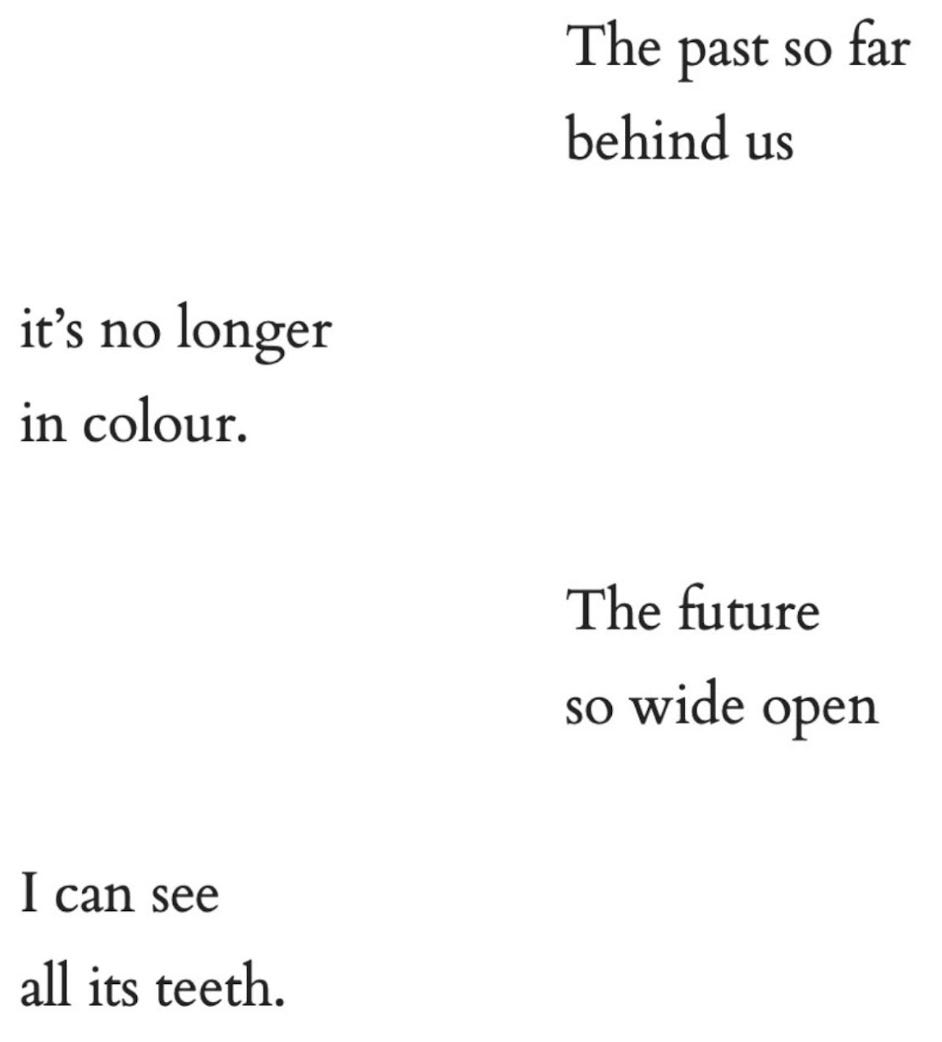
This one really hit me. ❤️